


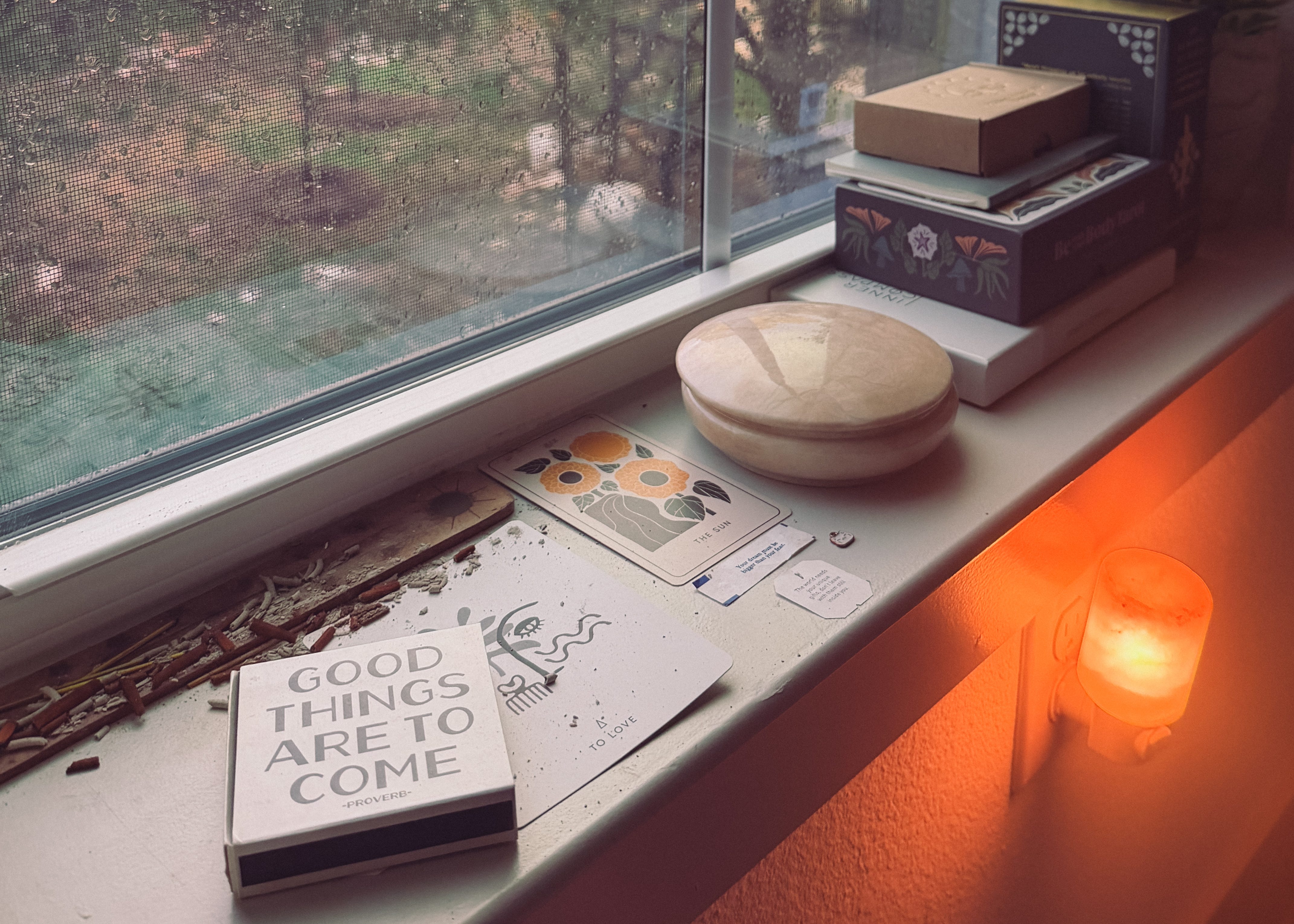
Words are my currency. I love to talk, I live to read, and I write most days. My home overflows with journals, books, and handwritten notes from friends, family, and past loves, both platonic and romantic. I contemplate words, look them up, and choose them with care. Sometimes a word captivates me; a recent week was marked by my searching for places to weave macabre into a sentence, and this week’s infatuation is impeccable. I teach, write, share essays, and podcast. Language is my love.
This devotion to words makes mantra my favorite yoga practice. Mantra embodies my belief in the transformative power of language. It allows me to connect deeply with words through the magic of ancient sound, the maitrika shakti. I’m currently studying with Jacob Kyle of Embodied Philosophy in Sadhana School. Much to my delight, this winter semester is devoted entirely to this subject. So much of our inquiry centers on the distinction between ancient and modern language. Our current language is largely used to indicate. The ancient was used to create.
As if the universe were underlining the lesson, reflections on the limits of language began appearing everywhere. Synchronicity seems to follow me when I’m paying attention. I was recently sent a thoughtful article by Cormac McCarthy, and that same week, another arrived in my inbox from Maria Popova . Two worthwhile, word-filled reflections circling a truth Eastern philosophy has long insisted upon: words fall short.
Just last week, walking to the salon in the cute Austin neighborhood where I work , I spotted a vanity plate that read “SOHOOD.” I immediately pulled out my notes app to jot down an essay prompt about my intrinsic mistrust of people with vanity plates. It’s the old paradox Alan Watts loved to illuminate: “Trying to define yourself is like trying to bite your own teeth.” Words are crude embodiments of deeper truths we cannot fully name. Watts spoke so clearly to this limitation of language: “You cannot put what it is into words. And this indeed is a central point of Zen and of Buddhist understanding in general: that reality is beyond words, and one must not confuse the world of things—as we think about them and name them—with the world as it actually is.”
This doesn’t stop any of us from trying to define things. It’s only natural to want to place a label or a name to understand and identify our mysterious selves and the general uncertainty of the world around us. Yet what are these definitions even if we aren’t actively living them? I’ve learned over time that those who talk the loudest are indeed sometimes all talk, unable to back up their bold proclamations with any direct action. Or even worse, acting in direct opposition to the words they espouse. An astrologer I adore, Colin Bedell, once said, “Integrity is security, and integrity is walking your talk.” We witness this in the actions of ourselves and others, that maybe that general hum of anxiety most people are feeling is just the incongruence of their words and motions.
Still, for all our philosophies about language’s shortcomings, life sometimes reveals the truth with striking clarity.
A few years ago, I had the immense privilege of sitting in a yoga classroom where students were invited to share. I no longer recall what prompted the reflection, only that it concerned the ineffable quality of the human soul. One student raised her hand and described losing both of her parents, one to dementia, the other to ALS. She recounted the differences between the two illnesses: the parent with dementia lost memory rapidly, preserving other faculties, while the parent with ALS lost the power to communicate entirely, trapped in a body that would no longer answer.
Yet, she said, in those final moments with each parent, the experience was indistinguishable.
It was the experience of sitting in the presence of pure love.
There was hardly a dry eye in the room. The irony that the student’s words illustrated to a room full of people: words do, in fact, fall short
.